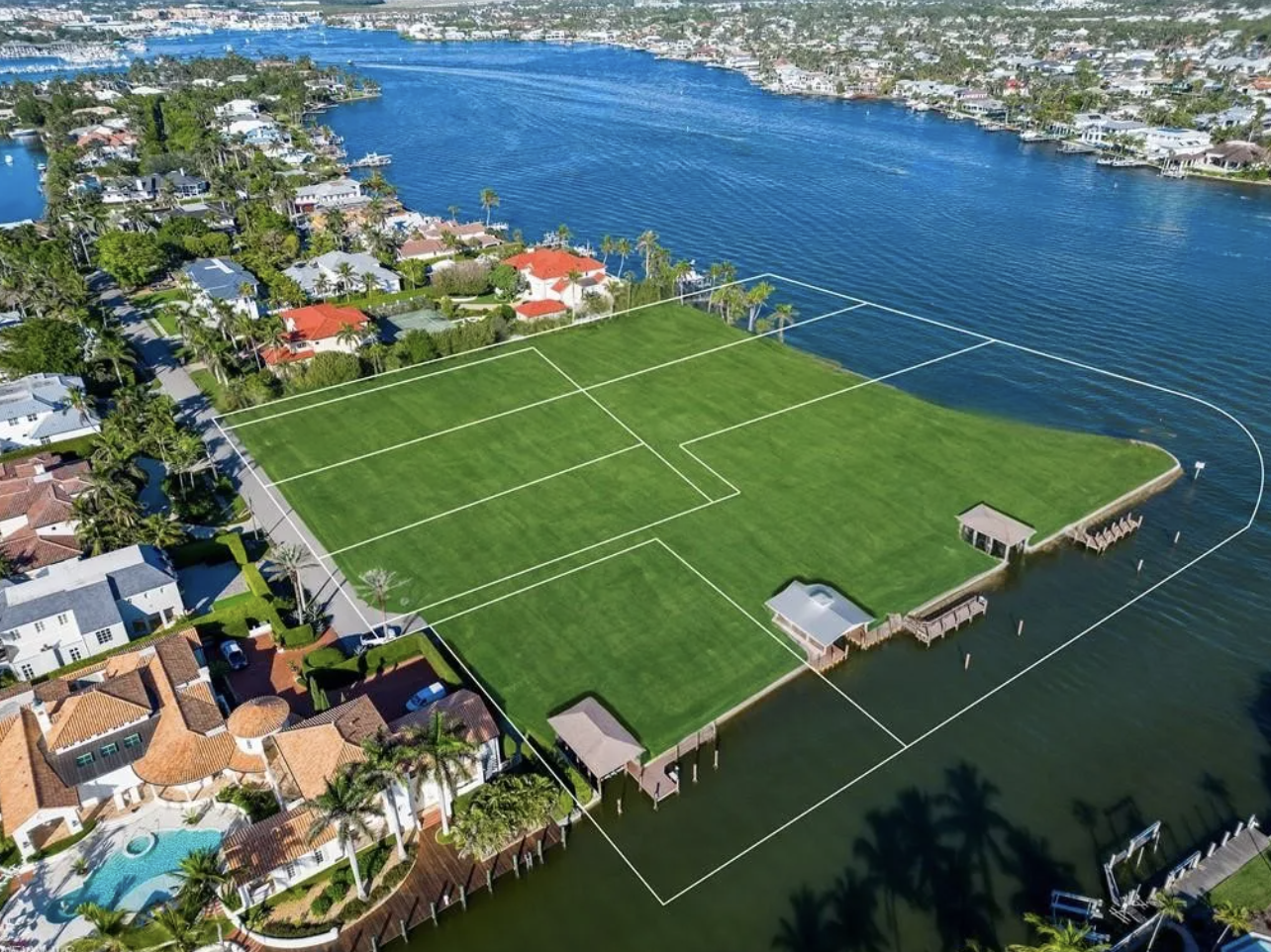

Naples, FL lot purchases are among the most consequential real estate decisions a buyer can make. The waterfront land supply in South Naples is finite and irreplaceable. Gulf-front lots in Port Royal do not come back to market routinely -- some have not changed hands in decades, and many of the most significant transactions happen off-market through broker relationships before a parcel is listed publicly. The buyers who understand what distinguishes a lot at a given price point from one at a 50 percent premium are the buyers who make decisions with clarity rather than urgency.
This is a systematic look at what Naples lot categories actually exist, what each costs, and what the due diligence requirements are for each tier before a buyer should consider going under contract.
The Lot Market in Four Tiers
Naples waterfront lot purchases fall into four categories that have meaningfully different characteristics, price ranges, and due diligence requirements. Understanding which tier a specific lot occupies is the first step in evaluating it.
Tier 1: Gulf-front. Direct frontage on the Gulf of Mexico with private beach. Exclusively concentrated in Port Royal on Gordon Drive and the streets that front the Gulf at the southern end of the peninsula. Supply is effectively fixed at fewer than two dozen lots in the entire Naples market. When Gulf-front lots in Port Royal trade, they rarely do so below $15M for land alone, and recent transactions have reset the ceiling. This tier carries the highest storm surge and wind exposure in the Naples market; insurance underwriting is a major variable in the ownership economics.
Tier 2: Bay-front and wide-water. Frontage on Naples Bay, Admiralty Bay, or the broader open-water sections of the Port Royal canal system where the water is wide enough to deliver expansive views and deep-water dockage. This tier trades from approximately $10M to $25M in Port Royal for vacant or teardown land. The water access is excellent -- Gordon's Pass to the Gulf is reachable in minutes by boat -- and the storm surge exposure, while still significant, is lower than direct Gulf-front. This is where the bulk of serious custom-build lot activity in Port Royal concentrates.
Tier 3: Canal-front. The majority of waterfront lots in Port Royal and Aqualane Shores front interior canals. This tier has the widest variation in actual product quality: a 120-foot lot on a 200-foot-wide canal with unrestricted boat access to Naples Bay is a fundamentally different product from a 70-foot lot on a 60-foot-wide canal with a fixed bridge between the property and open water. Price ranges in this tier run from approximately $4M to $12M. The due diligence requirements here are more intensive than any other tier precisely because lot quality varies so much within the category.
Tier 4: Non-waterfront. Interior lots within Port Royal and Aqualane Shores with no direct water access but carrying the enclave address, the Port Royal Club eligibility (for Port Royal lots), and proximity to the waterfront community. These lots trade from approximately $2M to $6M. The buyer is purchasing the address and the neighborhood, not water access, and the construction economics are more straightforward than waterfront lots because there are fewer site-specific variables.
The Gordon Drive Assemblage: What Record Land Transactions Tell You About the Market
The most significant lot transaction in Naples history was not a single-parcel sale. It was an assemblage -- the acquisition of four separate Gulf-front properties on Gordon Drive in Port Royal over approximately 14 months, culminating in a combined purchase price of $311M for nearly 19 Gulf-front acres.
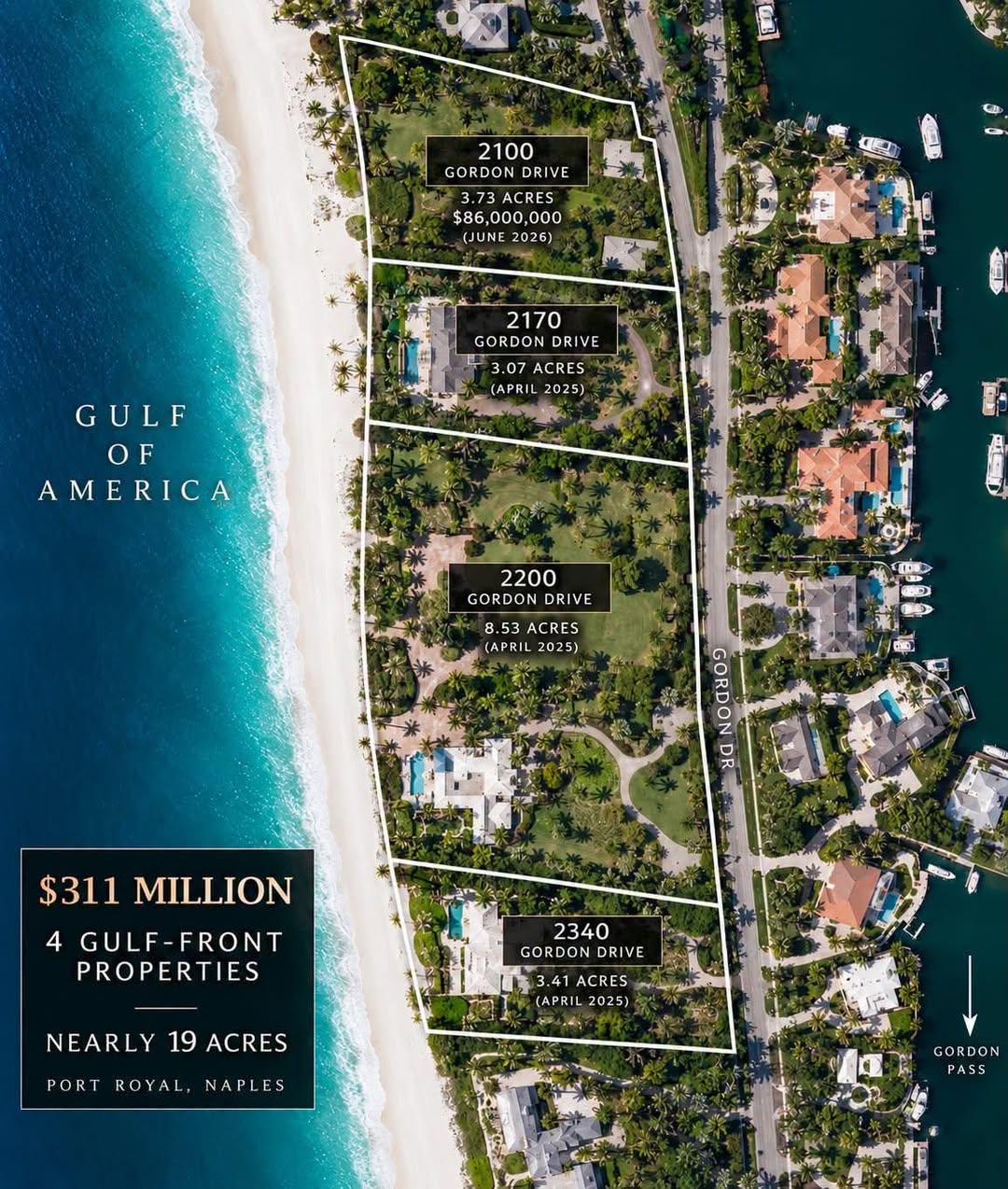
The individual parcel prices in this transaction are instructive for buyers at every lot tier in Naples. The final parcel -- 2100 Gordon Drive, 3.73 acres of Gulf-front land -- traded at $86M in June 2026, or approximately $23M per acre. The earlier parcels in the assemblage (acquired April 2025) reflected a lower per-acre basis because they were acquired before the full assemblage value became apparent to the market. This is the defining characteristic of assemblage economics: the buyer willing to hold individual parcels while patiently acquiring adjacent land captures the premium that comes from the assembled whole rather than the individual parts.
What this transaction tells buyers at all price tiers is structural: Gulf-front land in Naples has no functional ceiling because supply is genuinely finite and the number of buyers who can and want to operate at that level is not zero. For buyers in the $5M to $15M canal-front and bay-front tier, the message is different but related -- the same supply constraints that drive Gulf-front prices to $23M per acre apply, in a less extreme form, to every water-accessible parcel in Port Royal and Aqualane Shores. Land values in this market have one structural direction.
Canal-Front Due Diligence: The Checklist That Actually Matters
Canal-front lots in Naples produce more buyer regret per dollar invested than any other product category in the market, because the variables that determine whether a specific canal lot delivers what the buyer needs are rarely explained clearly by listing materials and require specific investigation before contract. Here is what matters:
Canal width at the property line. Naples canals range from under 60 feet to over 200 feet in width. A canal under 80 feet wide does not comfortably accommodate a vessel of significant size without maneuverability constraints. If the buyer intends to keep anything larger than a 35-foot to 40-foot boat, canal width at the specific parcel -- not the widest point of the canal -- is a threshold variable.
Canal depth (mean low water). Collier County canal depth varies by location and maintenance history. Many older canals in Naples have not been dredged in years and carry less water depth than their historical or marketing descriptions suggest. The buyer should obtain a bathymetric survey of the canal at the property's dock location before contract, not after.
Bridge clearances between the property and open water. Some canal lots in Naples have fixed bridges -- not drawbridges, but fixed concrete or masonry structures with a set clearance height above mean high water -- between the lot's dock and Naples Bay or Gordon's Pass. A fixed bridge with 14-foot clearance means no vessel with a fixed superstructure above 14 feet can transit from the property to open water under its own power. This is not disclosed in most listing materials and is not visible from a waterfront inspection of the property itself. It requires a physical survey of the entire canal route from the lot to open water. For a buyer whose intended vessel has a 20-foot air draft, a 14-foot fixed bridge makes the lot unsuitable regardless of its other characteristics.
Setback and coverage requirements. Collier County zoning establishes minimum setbacks from the seawall or mean high water line, minimum side-yard setbacks, and maximum impervious surface coverage ratios. These determine how close to the water a structure can be built, how wide the home can be on the lot, and what percentage of the lot can be covered by the home and hardscape combined. On a 75-foot-wide lot with 7.5-foot side setbacks, the maximum buildable width is 60 feet -- a constraint that affects floor plan design before an architect is engaged. These are publicly available from Collier County but need to be pulled and verified for the specific parcel's zoning classification before contract.
Building Timelines and Construction Economics
Buying a lot to build in Naples means accepting a 24-to-36-month timeline from contract on the land to occupancy of a finished home, assuming a smooth permitting and construction process. That timeline has several components: site plan and architectural design (typically 4 to 8 months for a significant custom project), permitting through Collier County (6 to 12 months for a coastal construction permit), and construction itself (12 to 18 months for a well-managed custom build). Each phase has the potential to extend beyond estimate.
Construction costs in Collier County for custom luxury residential have run approximately $600 to $900 per square foot for mid-to-high-spec new construction as of 2026, before site work, pool, landscaping, dock, and soft costs. A 7,000-square-foot home on a Port Royal canal lot might carry a construction budget of $5M to $7M in hard costs alone, before the $8M to $12M land basis, the architect's fees (typically 8 to 12 percent of construction cost), permitting fees, and financing carry during the build. Total project budgets for custom-build lots in Port Royal canal tier routinely exceed $20M all-in.
During the construction period, the buyer is carrying the full cost of land ownership -- property tax (Collier County effective rate approximately 1.0 to 1.1 percent on assessed value for unimproved land), insurance on the vacant parcel, and any financing carry. For a $10M lot financed at current rates, the annual holding cost during construction is not trivial. This is the economics case for buying an existing home rather than building in Naples: the finished product is available today, and the buyer is not carrying 30 months of construction-period costs on top of the land basis.
The case for building new is equally real: a home built to 2026 Florida Building Code standards has significantly upgraded wind resistance, impact-rated windows and doors, elevated foundation requirements, and mechanical systems that existing inventory -- particularly pre-2000 construction -- does not match. Post-Ian insurance has repriced substantially against older stock. A new-construction home in Port Royal may carry meaningfully lower annual insurance cost than a comparably-priced older home on the same street, and the gap between new and existing insurance premiums has widened since 2022.
The Assemblage Opportunity Below the Trophy Tier
The Gordon Drive assemblage at $311M is the most visible example of a strategy that plays out at smaller scale throughout the Naples waterfront lot market. Adjacent canal-front lots in Aqualane Shores and Port Royal can be assembled to create wider frontage, larger site area, and a more buildable envelope than any individual lot in the same location delivers. At the $5M to $15M per-lot price tier, assembling two adjacent 75-foot lots to create 150 feet of canal frontage is an entirely different product than the 75-foot lots individually -- and the per-foot premium on the assembled width can more than cover the premium paid to acquire the second lot.
These opportunities exist but are not advertised. They require local broker relationships with adjacent owners, a willingness to move on the first available parcel and hold it while the second is pursued, and a clear-eyed view of the site constraints for each individual parcel before the assembly is contemplated. The buyers who execute these strategies successfully are almost always represented by agents who operate in the specific sub-market at a level that surfaces these situations before they appear on listing services.
For related analysis: Naples market overview · Port Royal enclave guide · Naples country club guide · Naples waterfront guide · Florida home insurance guide · Boca Raton vs. Naples. Not legal, tax, or financial advice. Data as of November 2026.